
How RevealMyWay™ Works
RevealMyWay™ WellBeing Enrichment Tools
RevealMyWay™ is an integrated set of online knowledge tools — with optional support from a network of independent consultant coaches — that provide unparalleled self-awareness, insights, and structured guidance to help you increase your well-being by lessening unpleasant experiences and increasing pleasant ones.
RevealMyWay™ was conceived and developed by Dr. Stephen Beller, who has used it successfully in his psychotherapy practice for decades. A modernized version is available as a self-help tool for individuals and a support tool for practitioners (coaches, counselors, and therapists).
RevealMyWay™ has three integrated parts:
- Part 1 is the RevealMyWay™ Wellbeing Profiler (Profiler tool). It examines the pleasant and unpleasant aspects of a person’s life and thoughts, feelings, and coping mechanisms regarding troublesome situations. It offers interpretations and recommendations, in charts and text, that help the person determine one’s most meaningful experiences and ways to increase life satisfaction.
- Part 2 is the RevealMyWay™ Problem Management Guide (PMG tool). It helps a person deal effectively with difficult situations and unpleasant feelings. It employs a proven process that guides the person through steps to improve problems that can be changed and to cope emotionally with distressing situations that cannot.
- Part 3 is the RevealMyWay™ Periodic Profiler (PP) tool. The PP tool tracks trends in a person’s well-being status over time.
WellBeing Profiler Report Screen Shots
The following screenshots show some of the information in the RevealMyWay™ WellBeing Profiler report, which is about 15 pages long.
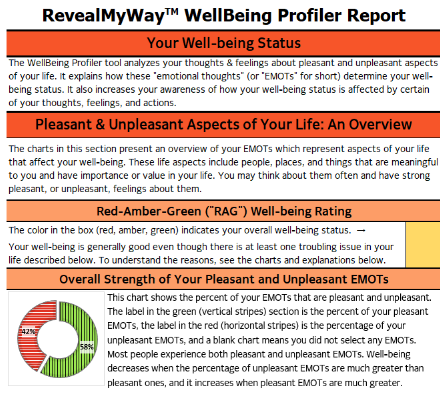
This is the first page of the Profiler report, which overviews its contents. It explains that well-being is measured by how much time a person spends thinking about certain pleasant and unpleasant things and how strongly they feel about them. These emotional thoughts are called “EMOTs.”
The “RAG” and “Donut” charts show the person’s overall well-being status in two ways.
Pleasant and Unpleasant Life Experiences
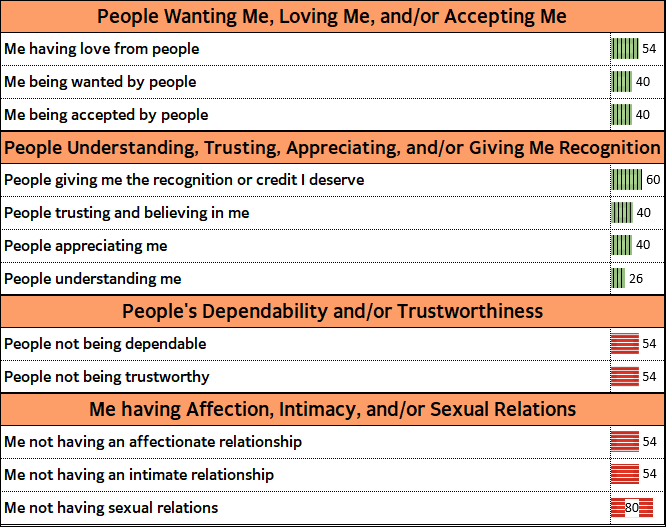
The chart below indicates the strength of a person’s EMOTs in different situations and contexts. Shown are 4 of 19 broad EMOT categories of the person’s life assessed by the Profiler tool.
Each EMOT category has 1 to 5 individual EMOTs, which use bar charts whose length and color indicate how much those EMOTs affect the person’s well-being by increasing or decreasing it.
The EMOTs within each category and the entire categories are sorted from most pleasant to most unpleasant or vice versa depending on the person’s preferences. For example, the chart below sorts and displays the pleasant EMOTs above the unpleasant ones.
Please Click on the Image to Enlarge
Well-being Trend Analysis
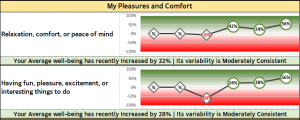
The trend charts produced by the RevealMyWay™ Periodic Profiler (PP) clearly show how a person’s well-being changes over time. A chart for each EMOT indicates average changes in a person’s well-being.
As shown below, the person’s overall well-being is improving over time. With additional PP data, well-being changes would be tracked more frequently for ongoing trend analysis. By reviewing these trends, self-help individuals and practitioners’ clients can gain deeper insights into the mindsets and life situations influencing their client’s well-being. This knowledge and understanding enable them to sharpen their focus on important issues to address.
Please Click on the Image to Enlarge
Coping Strategies (Methods)
The WellBeing Profiler assesses 14 ways of coping and their usefulness. The chart below indicates the effectiveness of a person’s strategies. The green portion indicates the percentage of helpful coping methods typically used to manage one’s problems, the red indicates the unhelpful amount, and the yellow shows how much is somewhat beneficial.
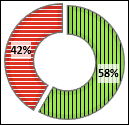
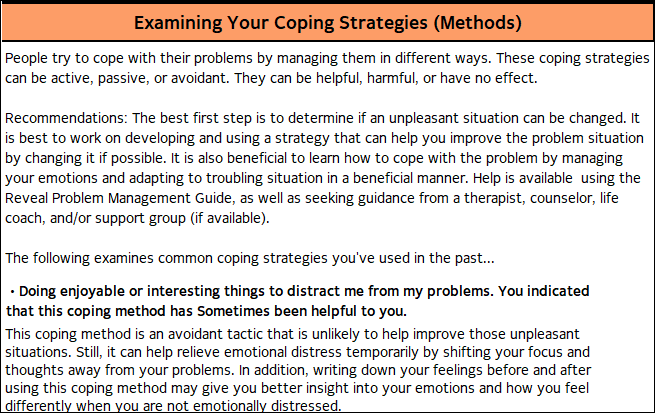
In addition, the report provides descriptions and explanations of a person’s coping methods and their helpfulness, such as the example below.
Troubling Thoughts
A person’s thoughts include beliefs, perceptions, judgments, memories, desires, expectations, intentions, ideas, etc. People have many thoughts every day; it is estimated that an average person typically has over 6,000 thoughts in a single day.
People’s thoughts about certain situations can burden their emotions, creating mental and physical distress. They are also called limiting thoughts, irrational beliefs, maladaptive core beliefs, dysfunctional assumptions, and negative automatic thoughts.
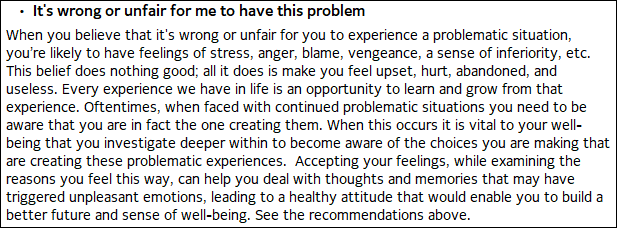
When people have such unhealthy thoughts, their unpleasant emotions increase, and their well-being decreases. The WellBeing Profiler assesses 16 types of troubling thoughts. As shown below, the report provides information that gives insights into the nature of specific harmful thoughts people have and what they can do about them:
Please Click on the Image to Enlarge
Problem-Management Guide (PMG)
The foundation of the PMG tool combines several approaches for managing situational problems, coping with stress, and reducing emotional distress.
It uses a 12-step problem-management model to help you improve changeable unpleasant situations and cope better with unchangeable ones by building a strategic plan for managing your chosen problem. It guides you in defining a main problem and then indicating:
- your thoughts & feelings about it,
- the goals you want to achieve,
- your perceived ability to overcome likely challenges,
- alternate solutions you can use,
- how to choose the best solution,
- how to monitor and evaluate your progress toward achieving your goals, and
- when to change your goals and solutions.
In addition, there are links to resources (videos, websites, articles, and coaches) that can assist you in answering the questions.
Independent Consultant Coach Support
Support is available from independent consultants worldwide who can help answer questions about the results of the RevealMyWay™ reports through video conferencing, phone conversation, and text messaging.
Practitioner-Support Tool
Many practitioners spend too much time getting the information needed to create meaningful interventions for their clients.
RevealMyWay™ digital tools help practitioners quickly and easily get vital knowledge about their clients to render timely care with effective results.
The tools do this by presenting in-depth data clients provide through simple online forms about how their thoughts, emotions, and coping behaviors impact their well-being. A practitioner who explores this information with clients strengthens their engagement. In addition, the insights gained augment clinical judgment and professional decisions.